ConvertReference.org

Cubic Centimeter To Quart Converter

cc

Review And Reference Information

Verified by the ConvertReference Technical Standards Team

ConvertReference Technical Standards Team

All values and formulas are validated through our editorial review process and cross-checked against internationally recognized reference standards (NIST, BIPM, CODATA).

View Editorial Standards & Report Corrections

Last reviewed: December 07, 2025

Conversion Factors

1 cubic centimeter = 0.00105668820943259 quart
1 quart = 946.352946 cubic centimeter

(Exact factors: 0.00105668820943259 and 946.352946)

Sources: NIST · BIPM

About This Cubic Centimeter And Quart Converter

This tool helps you compare volumes between cubic centimeters and quarts. The design is clean and easy to use for quick checks. Use the swap button to switch between cubic centimeters and quarts. Explore values with confidence and see clear results right away.

What Are Cubic Centimeters And Quarts?

What Is A Cubic Centimeter?

One cubic centimeter (cm^3, cc) is a unit of volume in the metric system. It is defined as the volume of a cube 1 cm on each side. In base units: 1 cm^3 = (0.01 m)^3 = 1e-6 m^3. It equals 1 mL in practical terms. Common symbols: cm^3 or cc; system: metric (SI-derived). Real-world example: a standard teaspoon holds about 5 cm^3 of liquid.

What Is A Quart?

Quart (qt) is a unit of volume used in US customary and British imperial systems. It is not an SI unit. US quart = 0.946352946 liters (1 qt = 0.000946352946 m^3); imperial quart = 1.1365225 liters (1 qt = 0.0011365225 m^3). Abbreviation: qt. Example: two pints make a quart.

When To Use Cubic Centimeter Vs Quart

Cubic Centimeter Usage

Cubic centimeter (cm^3) is used worldwide in metric contexts to measure small volumes, including medicines, laboratory work, and consumer products. It remains common in many countries that use the metric system. Primary users include China, Japan, Germany, and India.

Quart Usage

Quart is a familiar unit in the United States for cooking, beverages, and packaging. It is also encountered in the United Kingdom (imperial quart) and in Canada and Jamaica in limited contexts.

How To Convert Between Cubic Centimeters And Quarts

Conversion Formulas

Cubic Centimeter to Quart:
cubic centimeter × 0.00105668820943259 = quart

Quart to Cubic Centimeter:
quart × 946.352946 = cubic centimeter

Step-by-Step Guide

Cubic Centimeter to Quart

  1. Take your value in cubic centimeters.
  2. Multiply by 0.00105668820943259.
  3. The result is in quarts.

Quart to Cubic Centimeter

  1. Take your value in quarts.
  2. Multiply by 946.352946.
  3. The result is in cubic centimeters.

Example: Convert 2 cubic centimeters to quarts.

  • Exact: 2 × 0.00105668820943259 = 0.00211337641886519 quarts.
  • Rounded: approximately 0.00211338 quarts.

Example: Convert 5 quarts to cubic centimeters.

  • Exact: 5 × 946.352946 = 4731.76473 cubic centimeters.
  • Rounded: approximately 4731.76 cubic centimeters.

History & Context

Historically, the cubic centimeter grew from the idea of a small, precise volume in the metric system, used by scientists and engineers to measure liquids and medicines. It is defined by the cube of a centimeter, a standard unit in metric study that spread as Europe and other regions adopted decimal measures. The quart has roots in the English and imperial systems, tracing back to old trade and craft, where merchants used measures tied to larger containers. It became familiar in kitchens and markets, used for wine, beer, and household goods, and stood alongside the gallon and pint in daily life. The quart and the cubic centimeter follow different paths, in traditional trade and in modern science, yet both helped people compare, regulate, and understand volume in everyday work.

Practical Use

In a kitchen or lab, a volume measured in cubic centimeters might need to be converted to quarts to fit a standard quart container or measuring jug. This helps someone gauge how much liquid they have when a recipe or protocol lists amounts in cm3. Conversely, when scaling up a recipe or procedure, a person may need to convert a volume from quarts to cubic centimeters to measure precise amounts in metric units. Knowing both conversions helps prevent under- or over-measuring and keeps plans consistent across units.

Common Mistakes When Converting Between Cubic Centimeters And Quarts

  • Assuming cubic centimeters and quarts are the same size.
  • Using a linear dimension approach to a volume conversion.
  • Using the dry quart and liquid quart definitions interchangeably.
  • Relying on rough intuition instead of a proper unit conversion between metric and customary systems.

Mental Shortcuts For Quick Conversions

Tip 1 (cc to qt): 1 quart ≈ 1000 cubic centimeters; for rough estimates, divide cubic centimeters by 1000 to get quarts. Tip 2 (qt to cc): 1 quart ≈ 946 cubic centimeters; for rough estimates, multiply quarts by 1000 to get cubic centimeters. Note: this is an estimation only—use a precise converter for accuracy in most situations.

Cubic Centimeters And Quarts Conversion Graph
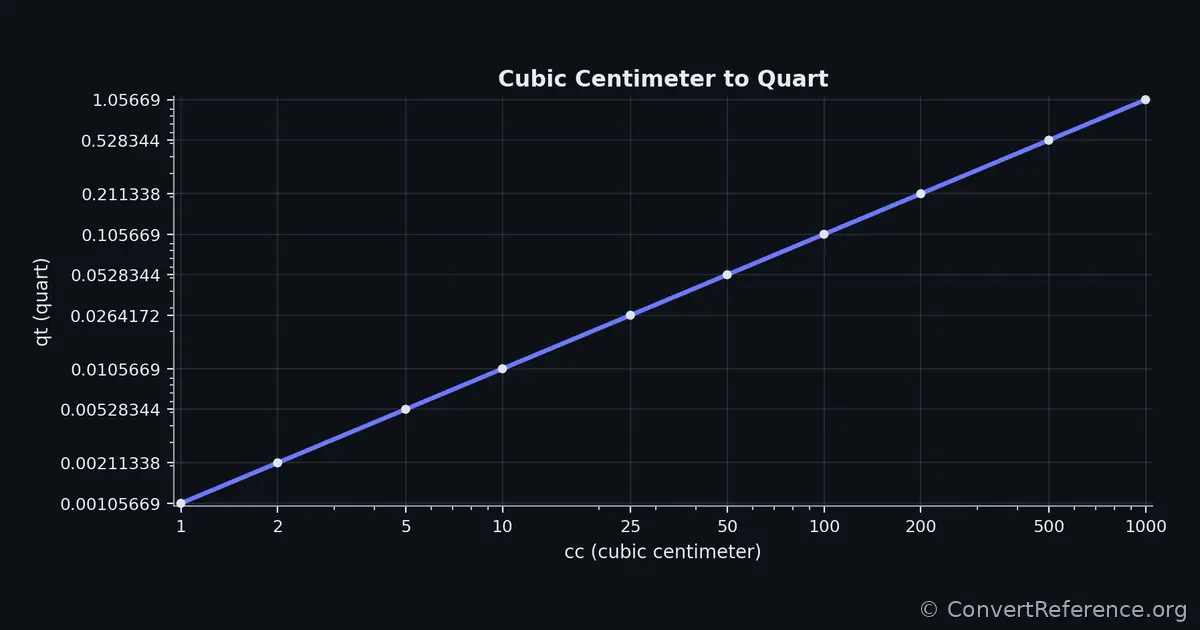
Cubic centimeters and Quarts Conversion Graph
Conversion graph showing the relationship between cubic centimeters and quarts.

Conversion Table For Cubic Centimeter And Quart

Common conversion values
Cubic centimeters Quarts
10.00105669
20.00211338
50.00528344
100.0105669
250.0264172
500.0528344
1000.105669
2000.211338
5000.528344
10001.05669

Values are rounded for display; internal calculations use the exact conversion factors between cubic centimeter and quart (0.00105668820943259 and 946.352946).

Dataset & API Access

Programmatic Access

Free JSON API with stable endpoints and predictable keys for automated bidirectional conversions.

Endpoint: https://convertreference.org/api/v1/convert/cubic-centimeter-to-quart.json

Content Type: application/json

Documentation: View API docs

Licensing

License: CC0 1.0 Universal (Public Domain)

See all datasets

Data & Editorial Process

All numerical values and formulas are generated from the Pint scientific unit library (v0.25), using constants consistent with the BIPM SI Brochure (9th Edition) and NIST Special Publication 811. Explanatory text is drafted with AI assistance and reviewed by ConvertReference editors for clarity and accuracy. This converter is completely free to use, and all calculations are performed locally in your browser and never sent to a server.

  • 2025-12-07 – Generated: Page created using Pint v0.25 verified constants.
  • 2025-12-07 – Reviewed: Verified by ConvertReference editors; no numerical changes required.