ConvertReference.org

Quart To Cubic Inch Converter

qt

Review And Reference Information

Verified by the ConvertReference Technical Standards Team

ConvertReference Technical Standards Team

All values and formulas are validated through our editorial review process and cross-checked against internationally recognized reference standards (NIST, BIPM, CODATA).

View Editorial Standards & Report Corrections

Last reviewed: December 07, 2025

Conversion Factors

1 quart = 57.75 cubic inch
1 cubic inch = 0.0173160173160173 quart

(Exact factors: 57.75 and 0.0173160173160173)

Sources: NIST · BIPM

About This Quart And Cubic Inch Converter

This quick converter helps you work with quarts and cubic inches. Use the swap button to switch between quarts and cubic inches. The result is shown clearly for your chosen units. It's ideal for fast, on-screen measurements and planning.

What Are Quarts And Cubic Inches?

What Is A Quart?

A quart is a unit of volume used in the US customary and British Imperial systems. Abbrev. qt. In the US system, 1 quart = 2 pints = 32 US fluid ounces = 0.946352946 liters. In the Imperial system, 1 quart = 2 pints = 40 imperial fluid ounces = 1.1365225 liters. Exact relation: 1 quart = 1/4 gallon. Real-world: a quart is about four cups of liquid.

What Is A Cubic Inch?

Cubic inch: the volume of a cube 1 inch on each side. In base units, 1 in^3 = (0.0254 m)^3 = 1.6387064e-5 m^3. It belongs to the imperial / US customary system. Symbol: in^3 (cu in). Example: a sugar cube (about 1 cm per side) is roughly 0.061 in^3.

When To Use Quart Vs Cubic Inch

Quart Usage

Quart is a unit of liquid capacity used primarily in the United States as part of the US customary system. It also appears in some contexts in the United Kingdom and in Caribbean nations such as Barbados and Jamaica, reflecting historical usage of larger customary units.

Cubic Inch Usage

Cubic inches are part of the US customary system and appear in everyday volume references in several English-speaking countries. They are used for small-volume measurements in the United States, the United Kingdom, Canada, and Australia, typically alongside metric units.

How To Convert Between Quarts And Cubic Inches

Conversion Formulas

Quart to Cubic Inch:
quart × 57.75 = cubic inch

Cubic Inch to Quart:
cubic inch × 0.0173160173160173 = quart

Step-by-Step Guide

Quart to Cubic Inch

  1. Take your value in quarts.
  2. Multiply by 57.75.
  3. The result is in cubic inches.

Cubic Inch to Quart

  1. Take your value in cubic inches.
  2. Multiply by 0.0173160173160173.
  3. The result is in quarts.

Example: Convert 1 quarts to cubic inches.

  • Exact: 1 × 57.75 = 57.75 cubic inches.

Example: Convert 5 cubic inches to quarts.

  • Exact: 5 × 0.0173160173160173 = 0.0865800865800866 quarts.
  • Rounded: approximately 0.0865801 quarts.

History & Context

Quart traces to old English and British wine and ale measures, where a fourth part of a gallon defined a convenient amount and later became a standard quart in imperial and American systems; in colonial times households, merchants, and brewers used it for liquids and dry goods, and the name itself recalls its origin as part of a larger measure. The cubic inch follows from the inch, a long standing standard of length in Britain and its colonies; people used cubes with an edge of an inch to gauge small volumes in crafts, engines, and tools, making the cubic inch a practical unit in early industry, until later rules unified practice.

Practical Use

A kitchen supplier packaging a quart-sized bottle wants to know if it will fit in a display case whose volume is listed in cubic inches, so they convert quart to cubic inch. They note that 1 quart equals about 57.75 cubic inches to compare the bottle's volume with crate space. In another scenario, a hobbyist pours resin into a mold and measures the required volume in cubic inches, then converts that amount to quarts to order the correct resin quantity. Converting cubic inches to quarts helps ensure the right amount is purchased for small-batch projects.

Common Mistakes When Converting Between Quarts And Cubic Inches

  • Quarts and cubic inches are the same size, so no conversion is needed.
  • There is no need to convert when switching between quart and cubic inch because they measure the same thing.
  • Converting from quart to cubic inch is impossible.
  • When converting, you can skip the conversion step and treat quarts as cubic inches.

Mental Shortcuts For Quick Conversions

Tip 1: 1 qt ≈ 58 in³; estimate by qt × 58. Tip 2: 1 in³ ≈ 0.0173 qt; estimate by in³ ÷ 58. Estimation only; use a precise converter when accuracy matters.

Quarts And Cubic Inches Conversion Graph
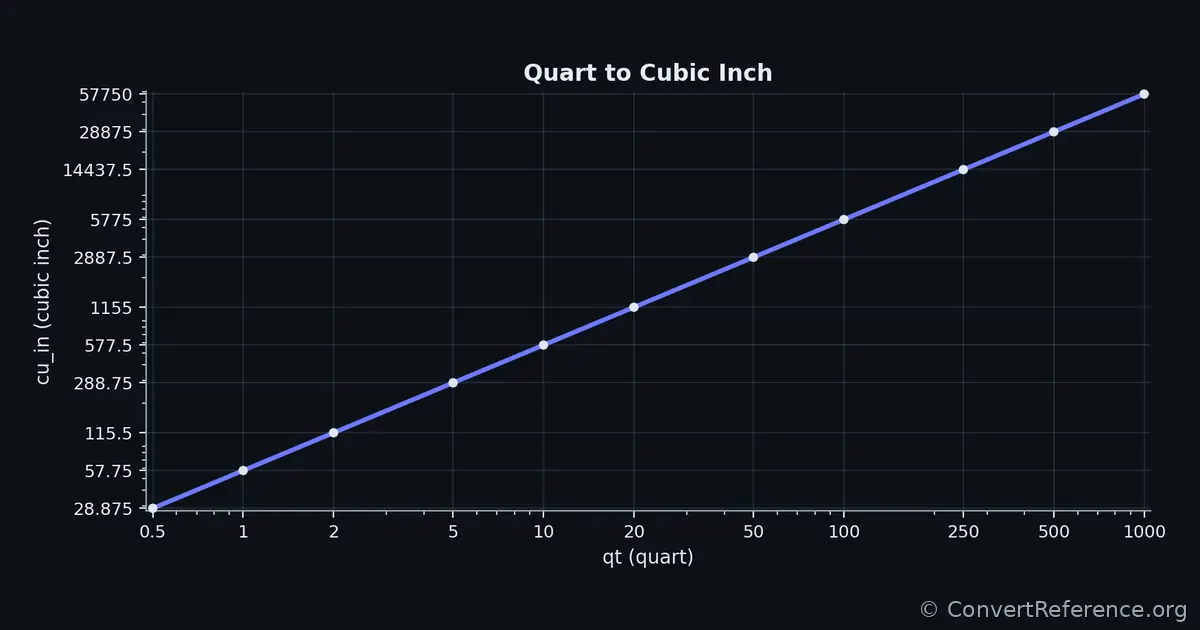
Quarts and Cubic inches Conversion Graph
Conversion graph showing the relationship between quarts and cubic inches.

Conversion Table For Quart And Cubic Inch

Common conversion values
Quarts Cubic inches
0.528.875
157.75
2115.5
5288.75
10577.5
201155
502887.5
1005775
25014437.5
50028875
100057750

Values are rounded for display; internal calculations use the exact conversion factors between quart and cubic inch (57.75 and 0.0173160173160173).

Dataset & API Access

Programmatic Access

Free JSON API with stable endpoints and predictable keys for automated bidirectional conversions.

Endpoint: https://convertreference.org/api/v1/convert/quart-to-cubic-inch.json

Content Type: application/json

Documentation: View API docs

Licensing

License: CC0 1.0 Universal (Public Domain)

See all datasets

Data & Editorial Process

All numerical values and formulas are generated from the Pint scientific unit library (v0.25), using constants consistent with the BIPM SI Brochure (9th Edition) and NIST Special Publication 811. Explanatory text is drafted with AI assistance and reviewed by ConvertReference editors for clarity and accuracy. This converter is completely free to use, and all calculations are performed locally in your browser and never sent to a server.

  • 2025-12-07 – Generated: Page created using Pint v0.25 verified constants.
  • 2025-12-07 – Reviewed: Verified by ConvertReference editors; no numerical changes required.