ConvertReference.org

Astronomical Unit to Kilometer and Kilometer to Astronomical Unit Converter (au to km, km to au)

au

Review And Reference Information

Verified by the ConvertReference Technical Standards Team

ConvertReference Technical Standards Team

All values and formulas are validated through our editorial review process and cross-checked against internationally recognized reference standards (NIST, BIPM, CODATA).

View Editorial Standards & Report Corrections

Last reviewed: December 01, 2025

Conversion Factors

1 astronomical unit = 149597870.7 kilometer
1 kilometer = 6.68458712226844e-9 astronomical unit

(Exact factors: 149597870.7 and 6.68458712226844e-9)

Sources: NIST · BIPM

About This Astronomical Unit And Kilometer Converter

Effortlessly compare astronomical units and kilometers with this quick and friendly calculator. It presents a clean, easy-to-read display for your distance values. If you need the other direction, you can click the swap button to switch between units. Use this tool to explore space distances with clarity and ease.

What Are Astronomical Units And Kilometers?

What Is An Astronomical Unit?

An astronomical unit (AU) is a unit of length equal to the average Earth-Sun distance. In SI terms, 1 AU is exactly 149,597,870,700 meters. It is used in solar-system astronomy and is abbreviated AU. Real-world example: the Earth-Sun distance is about 1 AU, roughly 149.6 million kilometers.

What Is A Kilometer?

Kilometer (km) is a unit of length in the SI system. It equals 1000 meters and is used for measuring longer distances between places. Its symbol is km. Example: a marathon is about 42.195 kilometers.

When To Use Astronomical Unit Vs Kilometer

Astronomical Unit Usage

An astronomical unit (AU) is used in astronomy and solar-system science to express distances within the solar system, such as Earth–Sun distances and orbits. It is commonly used in publications and teaching in the United States, United Kingdom, Canada, and Australia.

Kilometer Usage

The kilometer is a metric unit used worldwide to express distance. It is the standard measure for road distances and geographic extent in many countries. Examples include Germany, India, Brazil, and Australia.

How To Convert Between Astronomical Units And Kilometers

Conversion Formulas

Astronomical Unit to Kilometer:
astronomical unit × 149597870.7 = kilometer

Kilometer to Astronomical Unit:
kilometer × 6.68458712226844e-9 = astronomical unit

Step-by-Step Guide

Astronomical Unit to Kilometer

  1. Take your value in astronomical units.
  2. Multiply by 149597870.7.
  3. The result is in kilometers.

Kilometer to Astronomical Unit

  1. Take your value in kilometers.
  2. Multiply by 6.68458712226844e-9.
  3. The result is in astronomical units.

Example: Convert 2 astronomical units to kilometers.

  • Exact: 2 × 149597870.7 = 299195741.4 kilometers.
  • Rounded: approximately 2.99196e+8 kilometers.

Example: Convert 5 kilometers to astronomical units.

  • Exact: 5 × 6.68458712226844e-9 = 3.34229356113422e-8 astronomical units.
  • Rounded: approximately 3.34229e-8 astronomical units.

History & Context

Historically, astronomers used the distance from Earth to the Sun as a practical ruler for celestial calculations, refining ideas through observations of planetary motions and events such as alignments and transits. Over time, scholars named this distance the astronomical unit and kept it as a working measure in space science, even as more precise methods and gravitation theories shaped its meaning. The concept helped compare planets, moons, and spacecraft distances without a fixed ruler in the sky. The kilometer grew from the same spirit of standard measurement, born with the metric system in France to provide a simple unit for length.

Practical Use

In a spaceflight mission planning tool, distances are often given in astronomical units, which must be converted to kilometers to translate orbital positions into actionable propulsion and navigation data. Converting AU to kilometers helps engineers and planners visualize how far a target is from Earth and the Sun in familiar units during trajectory design. Conversely, when a science article presents a distance in kilometers, readers may convert to astronomical units to compare the distance to the Earth–Sun scale, such as assessing how many AUs a distant planet or asteroid lies away. Being able to switch between these units connects orbital concepts to real-world distances and supports clear intuition for readers.

Common Mistakes When Converting Between Astronomical Units And Kilometers

  • Confusing an astronomical unit with a kilometer.
  • Assuming the astronomical unit is a fixed number of kilometers that never changes.
  • Mistaking the astronomical unit for light-years or parsecs.
  • Converting in the wrong direction because you forget which unit is the input and which is the output.

Mental Shortcuts For Quick Conversions

AU→km: 1 AU ≈ 150 million km; estimate by multiplying by 1.5×10^8; for accuracy, use a precise converter. km→AU: 1 km ≈ 1/150,000,000 AU (about 6.7×10^-9 AU); estimate by dividing by 150 million; for accuracy, use a precise converter.

Astronomical Units And Kilometers Conversion Graph
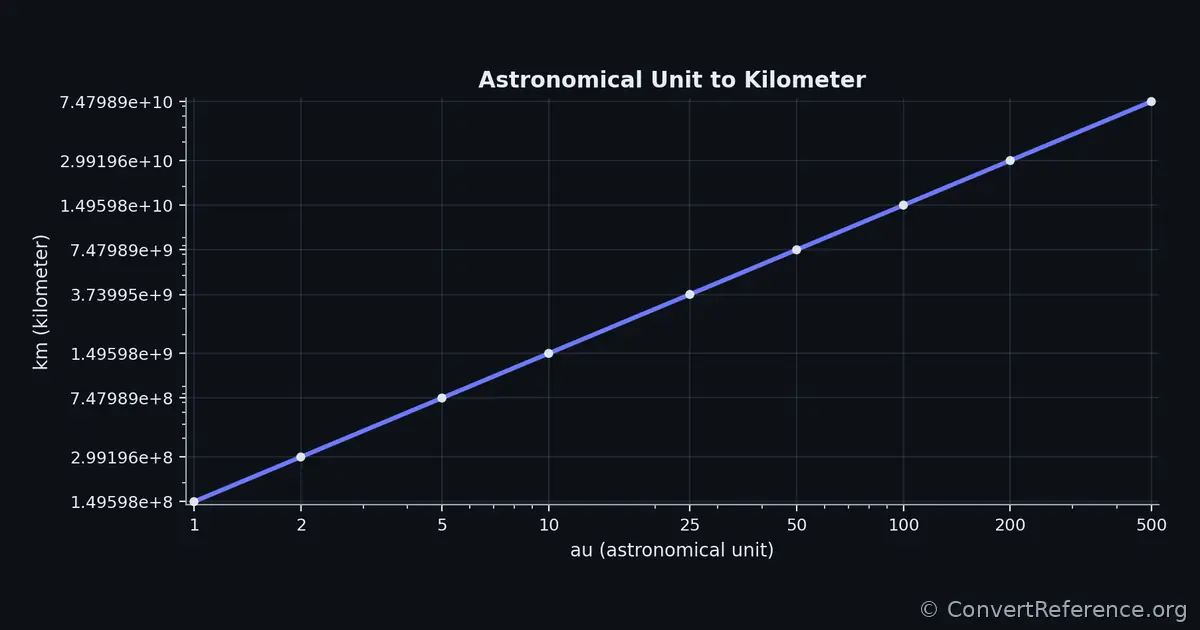
Astronomical units and Kilometers Conversion Graph
Conversion graph showing the relationship between astronomical units and kilometers.

Conversion Table For Astronomical Units And Kilometers

Common conversion values
Astronomical units Kilometers
11.49598e+8
22.99196e+8
57.47989e+8
101.49598e+9
253.73995e+9
507.47989e+9
1001.49598e+10
2002.99196e+10
5007.47989e+10

Values are rounded for display; internal calculations use the exact conversion factors between Astronomical Units and kilometers (149597870.7 and 6.68458712226844e-9).

Dataset & API Access

Programmatic Access

Free JSON API with stable endpoints and predictable keys for automated bidirectional conversions.

Endpoint: https://convertreference.org/api/v1/convert/astronomical-unit-to-kilometer.json

Content Type: application/json

Documentation: View API docs

Licensing

License: CC0 1.0 Universal (Public Domain)

See all datasets

Data & Editorial Process

All numerical values and formulas are generated from the Pint scientific unit library (v0.25), using constants consistent with the BIPM SI Brochure (9th Edition) and NIST Special Publication 811. Explanatory text is drafted with AI assistance and reviewed by ConvertReference editors for clarity and accuracy. This converter is completely free to use, and all calculations are performed locally in your browser and never sent to a server.

  • 2025-12-01 – Generated: Page created using Pint v0.25 verified constants.
  • 2025-12-01 – Reviewed: Verified by ConvertReference editors; no numerical changes required.