ConvertReference.org

Light Year to Kilometer and Kilometer to Light Year Converter (ly to km, km to ly)

ly

Review And Reference Information

Verified by the ConvertReference Technical Standards Team

ConvertReference Technical Standards Team

All values and formulas are validated through our editorial review process and cross-checked against internationally recognized reference standards (NIST, BIPM, CODATA).

View Editorial Standards & Report Corrections

Last reviewed: December 01, 2025

Conversion Factors

1 light year = 9460730472580.8 kilometer
1 kilometer = 1.05700083402462e-13 light year

(Exact factors: 9460730472580.8 and 1.05700083402462e-13)

Sources: NIST · BIPM

About This Light Year And Kilometer Converter

This tool helps you compare light years to kilometers. See the result in kilometers for your selected light year value. The interface is simple and fast, with a swap button to switch between units. Use it for a quick and clear distance check.

What Are Light Years And Kilometers?

What Is A Light Year?

Light-year is a unit of length equal to the distance light travels in one year in vacuum. It is defined from base units as 1 ly = c × 1 year ≈ 299,792,458 m/s × 31,557,600 s ≈ 9.4607×10^15 meters. It belongs to astronomical distances (not an SI base unit); symbol ly. Real‑world example: Proxima Centauri is about 4.24 ly away from Earth.

What Is A Kilometer?

Kilometer (km) is a unit of length in the metric system. It equals 1,000 meters (the meter is the SI base unit for length). It belongs to the International System of Units (SI). A typical distance is a 5-kilometer run, which is about 3.1 miles.

When To Use Light Year Vs Kilometer

Light Year Usage

Light-year is a distance unit used primarily in astronomy to describe interstellar and galactic distances. It appears in scientific literature, textbooks, and media representations in many countries, especially in the United States, United Kingdom, Canada, and Australia.

Kilometer Usage

Kilometer is part of the metric system used for measuring distance in many countries. It is common on maps, road signs, and everyday measurement in examples such as Canada, France, Japan, and Brazil.

How To Convert Between Light Years And Kilometers

Conversion Formulas

Light Year to Kilometer:
light year × 9460730472580.8 = kilometer

Kilometer to Light Year:
kilometer × 1.05700083402462e-13 = light year

Step-by-Step Guide

Light Year to Kilometer

  1. Take your value in light years.
  2. Multiply by 9460730472580.8.
  3. The result is in kilometers.

Kilometer to Light Year

  1. Take your value in kilometers.
  2. Multiply by 1.05700083402462e-13.
  3. The result is in light years.

Example: Convert 7 light years to kilometers.

  • Exact: 7 × 9460730472580.8 = 66225113308065.6 kilometers.
  • Rounded: approximately 6.62251e+13 kilometers.

Example: Convert 5 kilometers to light years.

  • Exact: 5 × 1.05700083402462e-13 = 5.28500417012308e-13 light years.
  • Rounded: approximately 5.285e-13 light years.

History & Context

Light year and kilometer are ways people describe distance in space and on Earth. The light year came from astronomy to talk about very far distances by tying them to how far light travels in a year. This idea helps scientists compare stars and galaxies without using huge numbers. The kilometer grows from the metric system, a global system for measuring length that started in Europe and spread widely in science, maps, and everyday use. The metric system gave a regular, easy way to measure length that fits many kinds of work.

Practical Use

Astronomers planning a spacecraft trajectory may need to convert light-years to kilometers to grasp the vast distance to a target in familiar units. Conversely, when summarizing distances in a space survey or comparing to cosmic scales, they translate kilometers to light-years to express how far away objects are in light-year terms. This dual conversion helps translate measurements into either practical mission planning metrics or broad astronomical context.

Common Mistakes When Converting Between Light Years And Kilometers

  • Confusing a light year with a calendar year.
  • Treating a light year as a unit of time rather than distance.
  • Assuming a direct kilometers to light years conversion without considering what a light year represents.
  • Using a generic distance conversion like kilometers for all units without recognizing the specific definition of a light year.

Mental Shortcuts For Quick Conversions

Ly to km: Mnemonic: '1 ly ≈ 9.5 trillion km' for quick estimates; estimation only—use a precise converter for exact results. Km to ly: Mnemonic: '1 km ≈ 1 in 10 trillion ly' for rough thinking; for accuracy, use a precise converter.

Light Years And Kilometers Conversion Graph
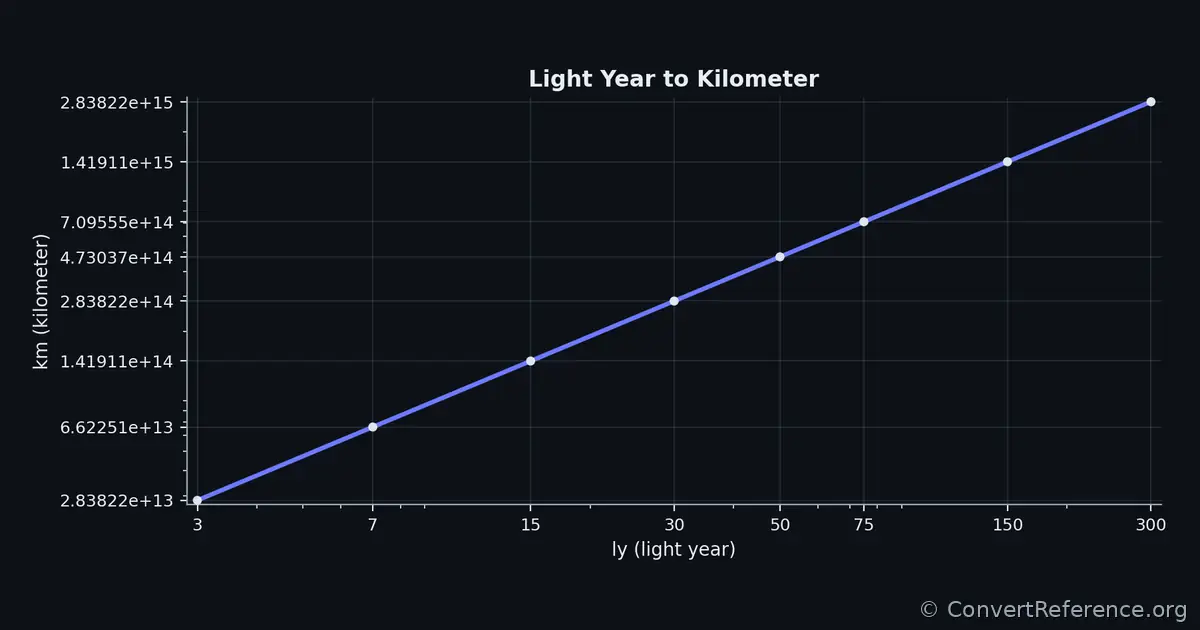
Light years and Kilometers Conversion Graph
Conversion graph showing the relationship between light years and kilometers.

Conversion Table For Light Years And Kilometers

Common conversion values
Light years Kilometers
32.83822e+13
76.62251e+13
151.41911e+14
302.83822e+14
504.73037e+14
757.09555e+14
1501.41911e+15
3002.83822e+15

Values are rounded for display; internal calculations use the exact conversion factors between Light Years and kilometers (9460730472580.8 and 1.05700083402462e-13).

Dataset & API Access

Programmatic Access

Free JSON API with stable endpoints and predictable keys for automated bidirectional conversions.

Endpoint: https://convertreference.org/api/v1/convert/light-year-to-kilometer.json

Content Type: application/json

Documentation: View API docs

Licensing

License: CC0 1.0 Universal (Public Domain)

See all datasets

Data & Editorial Process

All numerical values and formulas are generated from the Pint scientific unit library (v0.25), using constants consistent with the BIPM SI Brochure (9th Edition) and NIST Special Publication 811. Explanatory text is drafted with AI assistance and reviewed by ConvertReference editors for clarity and accuracy. This converter is completely free to use, and all calculations are performed locally in your browser and never sent to a server.

  • 2025-12-01 – Generated: Page created using Pint v0.25 verified constants.
  • 2025-12-01 – Reviewed: Verified by ConvertReference editors; no numerical changes required.