ConvertReference.org

Parsec to Light Year and Light Year to Parsec Converter (pc to ly, ly to pc)

pc

Review And Reference Information

Verified by the ConvertReference Technical Standards Team

ConvertReference Technical Standards Team

All values and formulas are validated through our editorial review process and cross-checked against internationally recognized reference standards (NIST, BIPM, CODATA).

View Editorial Standards & Report Corrections

Last reviewed: December 01, 2025

Conversion Factors

1 parsec = 3.26156377714188 light year
1 light year = 0.306601393787953 parsec

(Exact factors: 3.26156377714188 and 0.306601393787953)

Sources: NIST · BIPM

About This Parsec And Light Year Converter

This quick tool lets you compare parsec values with their light-year counterparts. It presents results clearly for easy interpretation. Use the swap button to switch between units. Enjoy a simple, focused interface designed for quick distance checks.

What Are Parsecs And Light Years?

What Is A Parsec?

Parsec (pc) is a unit of distance used in astronomy. It is defined as the distance at which one astronomical unit subtends an angle of one arcsecond. Therefore 1 parsec = 206,265 AU ≈ 3.085677581e16 meters. It belongs to astronomical distance units (not an SI base unit). Common symbol: pc. Example: Proxima Centauri is about 1.3 parsecs away, roughly 4.2 light-years.

What Is A Light Year?

Light-year: a unit of distance equal to the distance that light travels in one year in vacuum. In SI terms, 1 ly ≈ 9.461 × 10^15 meters (c ≈ 299,792,458 m/s × 1 year). It is an astronomical distance unit, derived from SI meters; symbol ly. Example: Proxima Centauri is about 4.24 light-years away, roughly 40 trillion kilometers.

When To Use Parsec Vs Light Year

Parsec Usage

Parsec is an astronomical distance unit used to express distances to stars and galaxies. It appears in scholarly literature and educational materials internationally, with primary usage in the United States, the United Kingdom, Canada, and Australia.

Light Year Usage

Light year is used in astronomy to describe distances to stars, galaxies, and other celestial objects. It appears in scientific literature and educational materials in many countries, including the United States, the United Kingdom, Germany, and Japan.

How To Convert Between Parsecs And Light Years

Conversion Formulas

Parsec to Light Year:
parsec × 3.26156377714188 = light year

Light Year to Parsec:
light year × 0.306601393787953 = parsec

Step-by-Step Guide

Parsec to Light Year

  1. Take your value in parsecs.
  2. Multiply by 3.26156377714188.
  3. The result is in light years.

Light Year to Parsec

  1. Take your value in light years.
  2. Multiply by 0.306601393787953.
  3. The result is in parsecs.

Example: Convert 0.5 parsecs to light years.

  • Exact: 0.5 × 3.26156377714188 = 1.63078188857094 light years.
  • Rounded: approximately 1.63078 light years.

Example: Convert 5 light years to parsecs.

  • Exact: 5 × 0.306601393787953 = 1.53300696893976 parsecs.
  • Rounded: approximately 1.53301 parsecs.

History & Context

Historically, astronomers needed a practical unit for great cosmic distances. The parsec was coined by the astronomer Herbert Turner in the early modern era, from parallax and arcsecond, to describe a distance tied to the tiny shift of stars as Earth orbits the Sun. It uses the idea that a star’s apparent movement defines a measurable angle when viewed from opposite sides of the orbit. The light year defines the distance that light travels in a year, a notion that grew once people understood light has a finite speed. It came into common use to express interstellar scales before larger units were widely adopted.

Practical Use

Astronomers mapping a nearby star cluster may convert parsecs to light-years to present distance estimates in the more widely used light-year units for broader audiences. This helps compare their measurements with publications and public charts that report distances in light-years. In an outreach setting, educators might convert light-years to parsecs to show students the numeric relationship between the units and how many parsecs correspond to a given light-year distance. Such conversions ensure consistency when translating scientific data for teaching materials and public resources.

Common Mistakes When Converting Between Parsecs And Light Years

  • Assuming a parsec and a light-year are the same unit of distance.
  • Applying a simple one-to-one factor to convert between parsecs and light-years.
  • Ignoring that a parsec is defined from parallax measurements rather than distance alone.
  • Using the wrong direction in the conversion between parsecs and light-years.

Mental Shortcuts For Quick Conversions

Tip 1: pc to ly — multiply by 3.26 (1 pc ≈ 3.26 ly). Tip 2: ly to pc — divide by 3.26 (≈0.3066 pc per ly). Estimation only—use a precise converter for exact results.

Parsecs And Light Years Conversion Graph
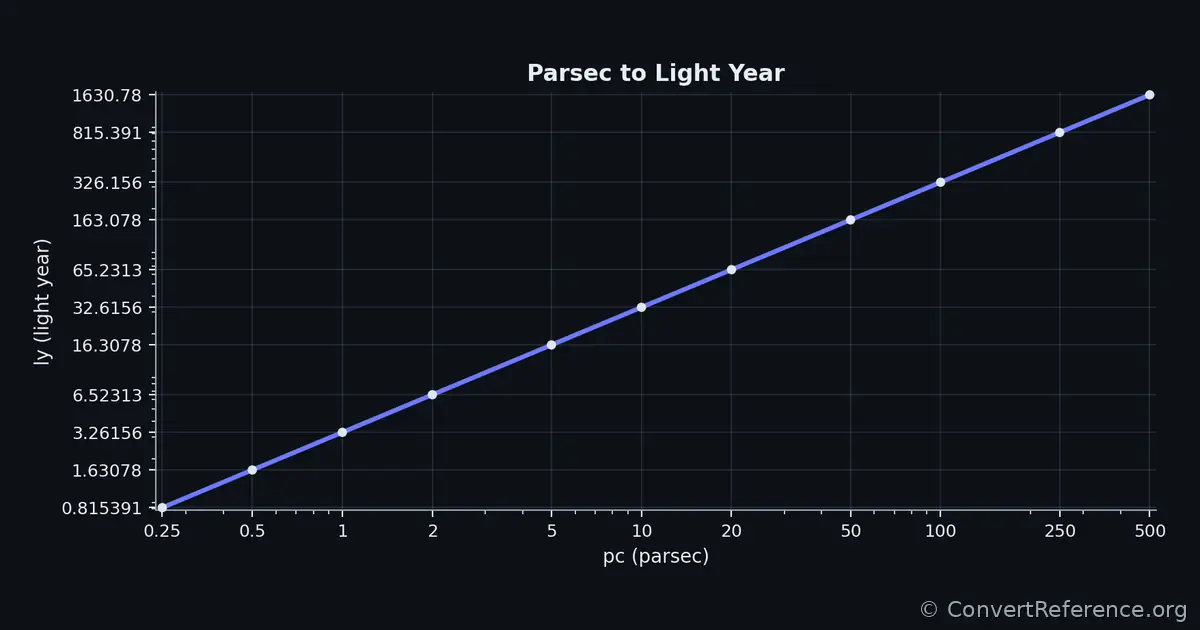
Parsecs and Light years Conversion Graph
Conversion graph showing the relationship between parsecs and light years.

Conversion Table For Parsecs And Light Years

Common conversion values
Parsecs Light years
0.250.815391
0.51.63078
13.26156
26.52313
516.3078
1032.6156
2065.2313
50163.078
100326.156
250815.391
5001630.78

Values are rounded for display; internal calculations use the exact conversion factors between parsecs and Light Years (3.26156377714188 and 0.306601393787953).

Dataset & API Access

Programmatic Access

Free JSON API with stable endpoints and predictable keys for automated bidirectional conversions.

Endpoint: https://convertreference.org/api/v1/convert/parsec-to-light-year.json

Content Type: application/json

Documentation: View API docs

Licensing

License: CC0 1.0 Universal (Public Domain)

See all datasets

Data & Editorial Process

All numerical values and formulas are generated from the Pint scientific unit library (v0.25), using constants consistent with the BIPM SI Brochure (9th Edition) and NIST Special Publication 811. Explanatory text is drafted with AI assistance and reviewed by ConvertReference editors for clarity and accuracy. This converter is completely free to use, and all calculations are performed locally in your browser and never sent to a server.

  • 2025-12-01 – Generated: Page created using Pint v0.25 verified constants.
  • 2025-12-01 – Reviewed: Verified by ConvertReference editors; no numerical changes required.