ConvertReference.org

Light Year to Meter and Meter to Light Year Converter (ly to m, m to ly)

ly

Review And Reference Information

Verified by the ConvertReference Technical Standards Team

ConvertReference Technical Standards Team

All values and formulas are validated through our editorial review process and cross-checked against internationally recognized reference standards (NIST, BIPM, CODATA).

View Editorial Standards & Report Corrections

Last reviewed: December 01, 2025

Conversion Factors

1 light year = 9.4607304725808e+15 meter
1 meter = 1.05700083402462e-16 light year

(Exact factors: 9.4607304725808e+15 and 1.05700083402462e-16)

Sources: NIST · BIPM

About This Light Year And Meter Converter

Welcome to our quick unit converter for light years and meters. This tool makes switching between units easy and intuitive. Use the swap button to switch between units at any time. Get the result instantly and continue exploring other values with confidence.

What Are Light Years And Meters?

What Is A Light Year?

A light-year is a unit of distance equal to the distance light travels in one year in vacuum. Exact relation: 1 ly = c × 1 Julian year (≈ 9.4607e15 m). System: SI (meters, seconds); symbol: ly. Example: Alpha Centauri is about 4.37 light-years from Earth.

What Is A Meter?

The meter (m) is the base unit of length in the International System of Units (SI). It is defined as the distance light travels in vacuum in 1/299,792,458 of a second. The symbol is m. Example: a standard doorway is about 2 meters tall.

When To Use Light Year Vs Meter

Light Year Usage

Used in astronomy for measuring interstellar distances; common in science education and literature in the United States, United Kingdom, Canada, and Australia.

Meter Usage

Meters are the standard unit of length in most countries, used in everyday measurement, education, science, and commerce. Examples include the United States, Canada, the United Kingdom, and Japan.

How To Convert Between Light Years And Meters

Conversion Formulas

Light Year to Meter:
light year × 9.4607304725808e+15 = meter

Meter to Light Year:
meter × 1.05700083402462e-16 = light year

Step-by-Step Guide

Light Year to Meter

  1. Take your value in light years.
  2. Multiply by 9.4607304725808e+15.
  3. The result is in meters.

Meter to Light Year

  1. Take your value in meters.
  2. Multiply by 1.05700083402462e-16.
  3. The result is in light years.

Example: Convert 2 light years to meters.

  • Exact: 2 × 9.4607304725808e+15 = 1.89214609451616e+16 meters.
  • Rounded: approximately 1.89215e+16 meters.

Example: Convert 5 meters to light years.

  • Exact: 5 × 1.05700083402462e-16 = 5.28500417012308e-16 light years.
  • Rounded: approximately 5.285e-16 light years.

History & Context

Light year is a way to describe very long distances in space. It links the speed of light to a year, so people can imagine how far light travels in that time. The term was adopted by astronomers to talk about the cosmos without writing huge numbers. The meter began as part of a plan in Europe to have a universal standard of length. It started as a physical bar kept in a government office and was used in science and everyday life. In later times, the meter was defined by fixing how far light travels in a given interval.

Practical Use

Astronomers planning a spacecraft trajectory or simulating interstellar travel often need to convert distances from light years to meters so the numbers can be used in physics equations. Conversely, educators presenting cosmic scales in classrooms or museums convert meters to light years to express vast distances in more intuitive units. This online unit converter page supports both directions, allowing quick conversions to fit calculations or clear explanations. Such conversions help bridge the gap between human intuition and astronomical measurements.

Common Mistakes When Converting Between Light Years And Meters

  • A light year is treated as a unit of time rather than distance.
  • Meters are confused with kilometers or miles instead of using the proper distance unit.
  • The conversion neglects that a fixed speed of light defines a light year.
  • A converted distance is interpreted as a time measurement.

Mental Shortcuts For Quick Conversions

Tip 1 (ly → m): 1 ly ≈ 9.46e15 m. Mnemonic: 'nine point four six quadrillion meters' for quick estimation. For precision, use a proper converter when exact results are needed. Tip 2 (m → ly): 1 m ≈ 1.06e-16 ly. Mnemonic: 'one meter is about one over ten to the sixteenth light-years' for quick recall. For precision, use a proper converter when exact results are needed.

Light Years And Meters Conversion Graph
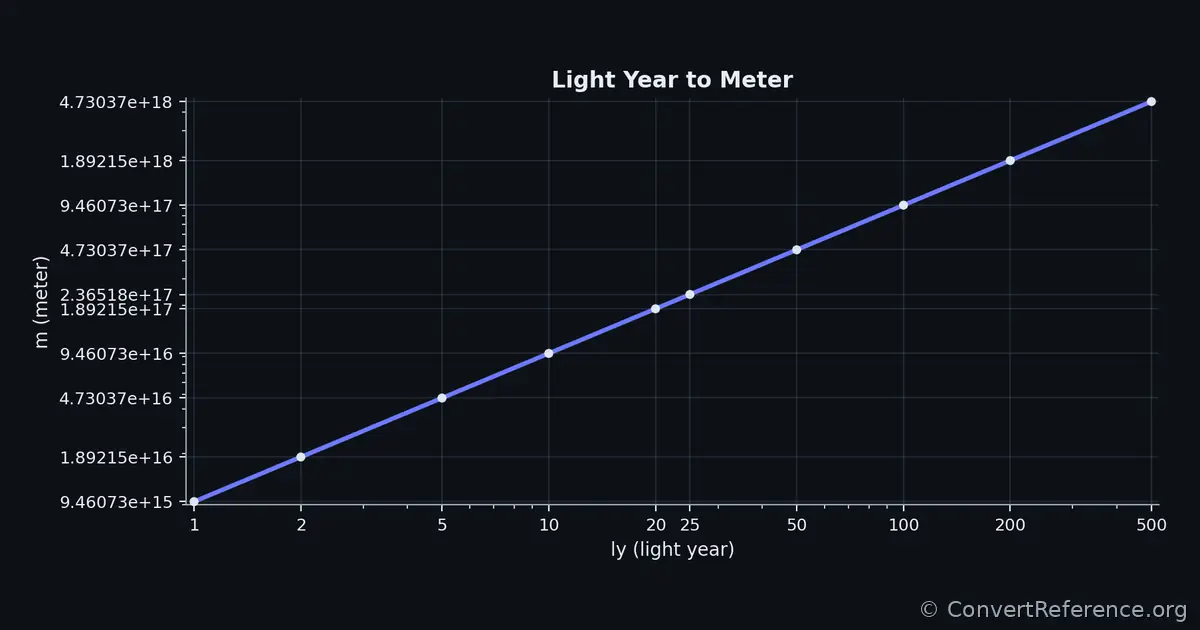
Light years and Meters Conversion Graph
Conversion graph showing the relationship between light years and meters.

Conversion Table For Light Years And Meters

Common conversion values
Light years Meters
19.46073e+15
21.89215e+16
54.73037e+16
109.46073e+16
201.89215e+17
252.36518e+17
504.73037e+17
1009.46073e+17
2001.89215e+18
5004.73037e+18

Values are rounded for display; internal calculations use the exact conversion factors between Light Years and meters (9.4607304725808e+15 and 1.05700083402462e-16).

Dataset & API Access

Programmatic Access

Free JSON API with stable endpoints and predictable keys for automated bidirectional conversions.

Endpoint: https://convertreference.org/api/v1/convert/light-year-to-meter.json

Content Type: application/json

Documentation: View API docs

Licensing

License: CC0 1.0 Universal (Public Domain)

See all datasets

Data & Editorial Process

All numerical values and formulas are generated from the Pint scientific unit library (v0.25), using constants consistent with the BIPM SI Brochure (9th Edition) and NIST Special Publication 811. Explanatory text is drafted with AI assistance and reviewed by ConvertReference editors for clarity and accuracy. This converter is completely free to use, and all calculations are performed locally in your browser and never sent to a server.

  • 2025-12-01 – Generated: Page created using Pint v0.25 verified constants.
  • 2025-12-01 – Reviewed: Verified by ConvertReference editors; no numerical changes required.