ConvertReference.org

Planck Length to Meter and Meter to Planck Length Converter (planck_length to m, m to planck_length)

planck_length

Review And Reference Information

Verified by the ConvertReference Technical Standards Team

ConvertReference Technical Standards Team

All values and formulas are validated through our editorial review process and cross-checked against internationally recognized reference standards (NIST, BIPM, CODATA).

View Editorial Standards & Report Corrections

Last reviewed: December 01, 2025

Conversion Factors

1 planck length = 1.6162550244237e-35 meter
1 meter = 6.18714240567674e+34 planck length

(Exact factors: 1.6162550244237e-35 and 6.18714240567674e+34)

Sources: NIST · BIPM

About This Planck Length And Meter Converter

Welcome to the Planck Length Converter, a quick tool for working with Planck length and meters. Enter your number in Planck length and see the result in meters. Use the swap button to switch between units. Experiment with values and compare the two units with ease.

What Are Planck Lengths And Meters?

What Is A Planck Length?

Planck length (ℓP) is the length scale where quantum gravity becomes important. It equals sqrt(ħ G / c^3) and is about 1.616e-35 meters. It is defined from base SI constants (ħ, G, c) and is the standard unit in Planck (natural) units. Common symbol: ℓP or lP. Example: a proton (~1e-15 m) is roughly 1e20 Planck lengths across.

What Is A Meter?

The meter is the base SI unit of length. It is defined as the distance light travels in vacuum in 1/299,792,458 of a second. System: International System of Units (SI). Symbol: m. Real-world example: a standard doorway is about 2 meters tall.

When To Use Planck Length Vs Meter

Planck Length Usage

Planck length is a theoretical scale used in fundamental physics to explore quantum gravity and Planck-scale phenomena. It appears in quantum gravity, string theory, loop quantum gravity, and early-universe models. It is used by researchers in the United States, United Kingdom, Germany, and France.

Meter Usage

The meter is the standard unit of length in most countries. It is used in daily life and in education in Canada, the United Kingdom, Japan, and Germany.

How To Convert Between Planck Lengths And Meters

Conversion Formulas

Planck Length to Meter:
planck length × 1.6162550244237e-35 = meter

Meter to Planck Length:
meter × 6.18714240567674e+34 = planck length

Step-by-Step Guide

Planck Length to Meter

  1. Take your value in planck lengths.
  2. Multiply by 1.6162550244237e-35.
  3. The result is in meters.

Meter to Planck Length

  1. Take your value in meters.
  2. Multiply by 6.18714240567674e+34.
  3. The result is in planck lengths.

Example: Convert 70 planck lengths to meters.

  • Exact: 70 × 1.6162550244237e-35 = 1.13137851709659e-33 meters.
  • Rounded: approximately 1.13138e-33 meters.

Example: Convert 5 meters to planck lengths.

  • Exact: 5 × 6.18714240567674e+34 = 3.09357120283837e+35 planck lengths.
  • Rounded: approximately 3.09357e+35 planck lengths.

History & Context

Planck length is a unit from the early quantum era. The physicist Max Planck proposed natural units made from fundamental constants, describing a tiny length where quantum effects matter. The idea helped shift thinking from everyday rulers to universal scales. The meter has a longer and well documented history. It began with a physical bar of platinum and iridium kept in Paris as the standard of length. Later, the definition moved to measurements tied to the speed of light, so that length could be reproduced anywhere by precise physics rather than a single object. The story shows a move from concrete artifacts to definitions grounded in nature.

Practical Use

Scientists in theoretical or experimental physics might need to convert a measurement expressed in Planck length to meters in order to relate a hypothesized quantum-scale distance to observable lab scales. Conversely, when modeling or simulating objects at the smallest possible sizes, researchers convert meters to Planck length to express dimensions in fundamental units. This online converter page provides a quick way to perform either direction for study, design, or teaching purposes.

Common Mistakes When Converting Between Planck Lengths And Meters

  • Confusing the Planck length with a standard SI prefix and treating it like a simple multiplier of meters.
  • Assuming a direct, simple meter-to-Planck-length conversion without acknowledging that it is a derived unit defined by fundamental constants.
  • Applying everyday length intuition to Planck-length conversions instead of respecting its unique physical definition.
  • Relying on rough approximations or rounding during Planck length conversions instead of using the precise, defined relationship.

Mental Shortcuts For Quick Conversions

Tip 1: Planck → meters: memorize 1 planck length ≈ 1.6e-35 m (about 1.6 × 10^-35 m); for quick estimates just use 1 planck ≈ 1.6e-35 m. Tip 2: Meters → planck lengths: 1 m ≈ 6.2e34 planck lengths. Note: this is for estimation only; use a precise converter in most situations.

Planck Lengths And Meters Conversion Graph
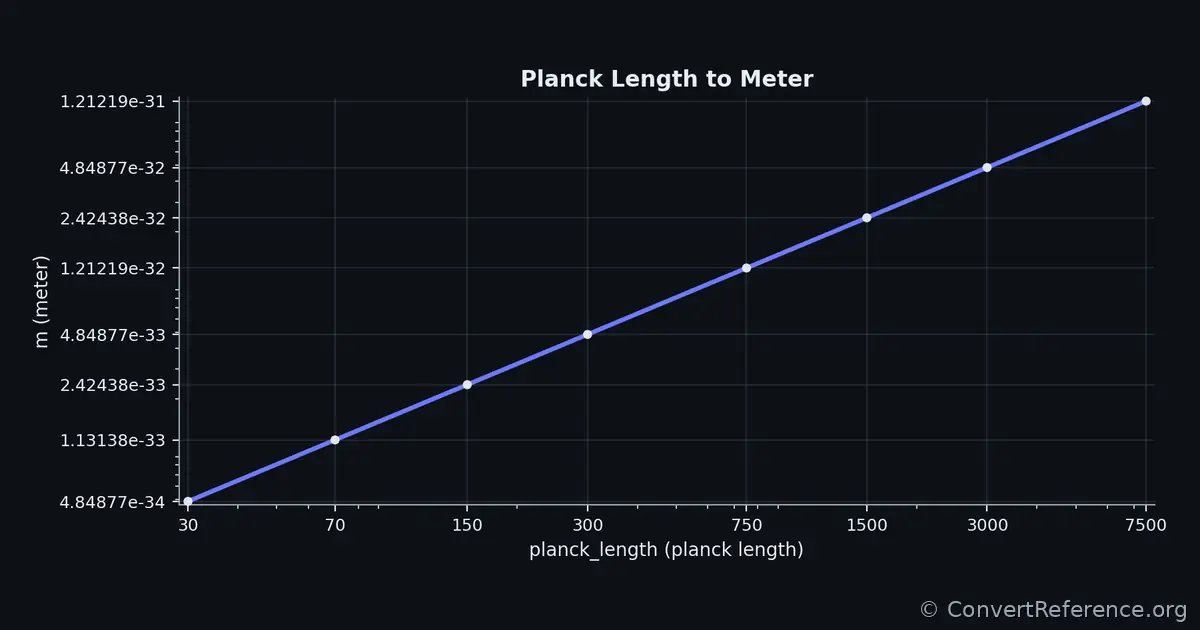
Planck lengths and Meters Conversion Graph
Conversion graph showing the relationship between planck lengths and meters.

Conversion Table For Planck Lengths And Meters

Common conversion values
Planck lengths Meters
304.84877e-34
701.13138e-33
1502.42438e-33
3004.84877e-33
7501.21219e-32
15002.42438e-32
30004.84877e-32
75001.21219e-31

Values are rounded for display; internal calculations use the exact conversion factors between Planck Lengths and meters (1.6162550244237e-35 and 6.18714240567674e+34).

Dataset & API Access

Programmatic Access

Free JSON API with stable endpoints and predictable keys for automated bidirectional conversions.

Endpoint: https://convertreference.org/api/v1/convert/planck-length-to-meter.json

Content Type: application/json

Documentation: View API docs

Licensing

License: CC0 1.0 Universal (Public Domain)

See all datasets

Data & Editorial Process

All numerical values and formulas are generated from the Pint scientific unit library (v0.25), using constants consistent with the BIPM SI Brochure (9th Edition) and NIST Special Publication 811. Explanatory text is drafted with AI assistance and reviewed by ConvertReference editors for clarity and accuracy. This converter is completely free to use, and all calculations are performed locally in your browser and never sent to a server.

  • 2025-12-01 – Generated: Page created using Pint v0.25 verified constants.
  • 2025-12-01 – Reviewed: Verified by ConvertReference editors; no numerical changes required.