ConvertReference.org

Bohr to Meter and Meter to Bohr Converter (a_0 to m, m to a_0)

a_0

Review And Reference Information

Verified by the ConvertReference Technical Standards Team

ConvertReference Technical Standards Team

All values and formulas are validated through our editorial review process and cross-checked against internationally recognized reference standards (NIST, BIPM, CODATA).

View Editorial Standards & Report Corrections

Last reviewed: December 01, 2025

Conversion Factors

1 bohr = 5.29177210543883e-11 meter
1 meter = 18897261259.082 bohr

(Exact factors: 5.29177210543883e-11 and 18897261259.082)

Sources: NIST · BIPM

About This Bohr And Meter Converter

Welcome to the bohr to meter converter. Type a value in bohr to see the corresponding measurement in meters. Use the swap button to switch between bohr and meter views. This tool is fast, clear, and ready when you are.

What Are Bohrs And Meters?

What Is A Bohr?

Bohr (Bohr radius), symbol a0, is a unit of length used in atomic physics. It is defined as a0 = 4*pi*epsilon0*hbar^2 / (me*e^2) meters, about 5.29177e-11 m. It belongs to atomic/quantum units. 1 Bohr ≈ 0.529 Angstroms. Real-world scale: about the size of a hydrogen atom; a typical C-C bond is ~1.54 Angstroms, about 3 Bohrs across.

What Is A Meter?

Meter (m) is the SI base unit of length. It is defined as the distance light travels in vacuum in 1/299,792,458 of a second (c = 299,792,458 m/s). System: SI (Systeme International). Symbol: m. Example: a standard doorway is about 2 meters tall.

When To Use Bohr Vs Meter

Bohr Usage

The Bohr (Bohr radius) is used as a length unit in atomic physics and quantum chemistry. It appears in scientific calculations, literature, and education in many countries. Primary users include the United States, United Kingdom, Germany, and France.

Meter Usage

The meter is the standard unit of length in the metric system, used for measurements in daily life and science in many countries, including the United States, the United Kingdom, Canada, and Japan.

How To Convert Between Bohrs And Meters

Conversion Formulas

Bohr to Meter:
bohr × 5.29177210543883e-11 = meter

Meter to Bohr:
meter × 18897261259.082 = bohr

Step-by-Step Guide

Bohr to Meter

  1. Take your value in bohrs.
  2. Multiply by 5.29177210543883e-11.
  3. The result is in meters.

Meter to Bohr

  1. Take your value in meters.
  2. Multiply by 18897261259.082.
  3. The result is in bohrs.

Example: Convert 10 bohrs to meters.

  • Exact: 10 × 5.29177210543883e-11 = 5.29177210543883e-10 meters.
  • Rounded: approximately 5.29177e-10 meters.

Example: Convert 5 meters to bohrs.

  • Exact: 5 × 18897261259.082 = 94486306295.41 bohrs.
  • Rounded: approximately 9.44863e+10 bohrs.

History & Context

Bohr was a Danish physicist whose atomic model offered a simple picture of electrons circling a nucleus and emitting light when they jump between energy states. His idea made sense of spectral lines and helped shape the modern view of quantum physics, influencing chemistry, physics, and technology for generations. The meter’s history begins with a search for a universal unit of length. A highly precise standard was kept in a Paris laboratory as a metal bar, and later the definition moved to a natural constant linked to how fast light travels in vacuum, promising equal length everywhere and at all times. Together, these stories show how theory and standard definitions pushed science toward shared rules and reliable measurements.

Practical Use

Researchers might need to convert bohr to meters when translating atomic-scale distances, such as the Bohr radius, into familiar SI units to compare electron orbit sizes with macroscopic measurements. For example, 1 Bohr is about 5.29e-11 meters, so expressing a hydrogen atom's radius in meters helps relate it to real-world sizes. Conversely, engineers working with nanoscale devices may convert meters to bohr to express large dimensions in atomic units for simulations and theoretical models. A 1 nanometer feature, about 1e-9 meters, corresponds to roughly 19 Bohr radii, illustrating how the two systems connect.

Common Mistakes When Converting Between Bohrs And Meters

  • Treating the Bohr radius as if it were just another meter without considering its quantum origin.
  • Assuming there is a simple direct equivalence between Bohr units and meters without respecting the proper context.
  • Using a meter based mindset when converting from Bohr to meters, which misreads the conversion direction.
  • Ignoring that the Bohr radius is defined by fundamental constants and is not a general length scale.

Mental Shortcuts For Quick Conversions

Bohr to meter: 1 Bohr ~ 5.3e-11 m; estimate by multiplying by 5.3e-11. Meter to Bohr: 1 m ~ 1.89e10 Bohr radii; estimate by multiplying by 1.89e10. Note: estimation only; use a precise converter for accuracy.

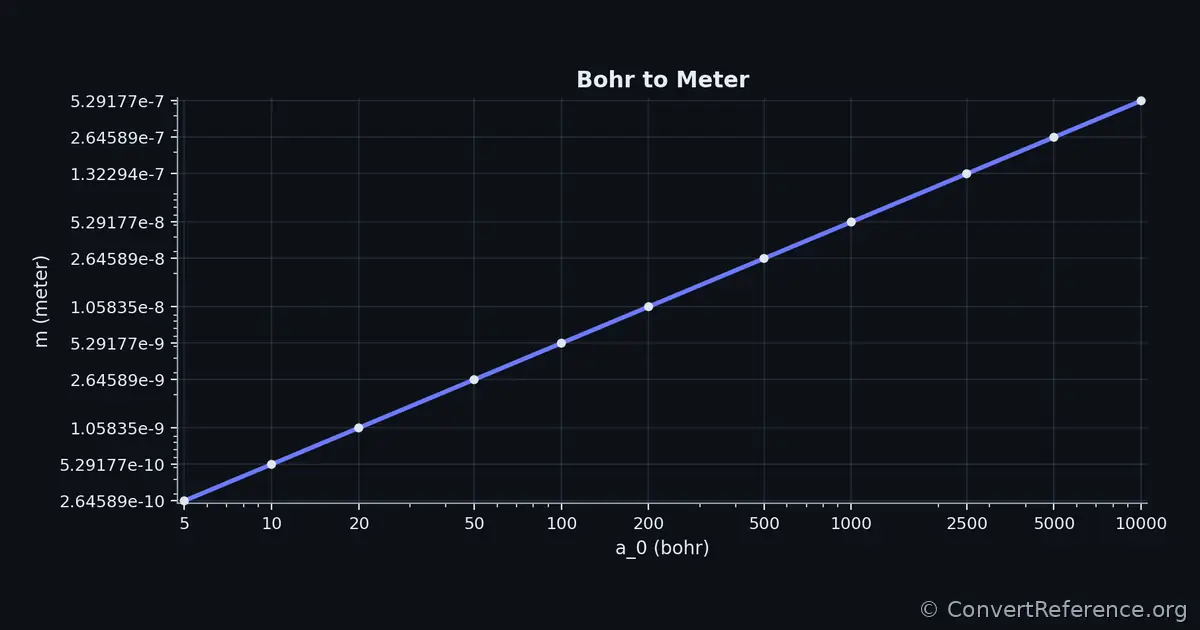
Bohrs And Meters Conversion Graph

Bohrs and Meters Conversion Graph
Conversion graph showing the relationship between bohrs and meters.

Conversion Table For Bohrs And Meters

Common conversion values
Bohrs Meters
52.64589e-10
105.29177e-10
201.05835e-9
502.64589e-9
1005.29177e-9
2001.05835e-8
5002.64589e-8
10005.29177e-8
25001.32294e-7
50002.64589e-7
100005.29177e-7

Values are rounded for display; internal calculations use the exact conversion factors between bohrs and meters (5.29177210543883e-11 and 18897261259.082).

Dataset & API Access

Programmatic Access

Free JSON API with stable endpoints and predictable keys for automated bidirectional conversions.

Endpoint: https://convertreference.org/api/v1/convert/bohr-radius-to-meter.json

Content Type: application/json

Documentation: View API docs

Licensing

License: CC0 1.0 Universal (Public Domain)

See all datasets

Data & Editorial Process

All numerical values and formulas are generated from the Pint scientific unit library (v0.25), using constants consistent with the BIPM SI Brochure (9th Edition) and NIST Special Publication 811. Explanatory text is drafted with AI assistance and reviewed by ConvertReference editors for clarity and accuracy. This converter is completely free to use, and all calculations are performed locally in your browser and never sent to a server.

  • 2025-12-01 – Generated: Page created using Pint v0.25 verified constants.
  • 2025-12-01 – Reviewed: Verified by ConvertReference editors; no numerical changes required.