ConvertReference.org

Astronomical Unit to Meter and Meter to Astronomical Unit Converter (au to m, m to au)

au

Review And Reference Information

Verified by the ConvertReference Technical Standards Team

ConvertReference Technical Standards Team

All values and formulas are validated through our editorial review process and cross-checked against internationally recognized reference standards (NIST, BIPM, CODATA).

View Editorial Standards & Report Corrections

Last reviewed: December 01, 2025

Conversion Factors

1 astronomical unit = 149597870700 meter
1 meter = 6.68458712226844e-12 astronomical unit

(Exact factors: 149597870700 and 6.68458712226844e-12)

Sources: NIST · BIPM

About This Astronomical Unit And Meter Converter

This handy unit converter makes it easy to compare astronomical units to meters. Enter a value in astronomical units and see the corresponding distance in meters. A swap button lets you switch between units with a click. Clear results help you explore space measurements with confidence.

What Are Astronomical Units And Meters?

What Is An Astronomical Unit?

An astronomical unit (AU) is a unit of distance used in astronomy, defined as the average distance from the Earth to the Sun. Exact relation: 1 AU = 149,597,870,700 meters (exact). It is not an SI unit; it belongs to the astronomical units system. Symbol: AU. Example: 1 AU ≈ 149.6 million km (about 93 million miles).

What Is A Meter?

Meter (m) is the SI base unit of length. It is defined as the distance light travels in vacuum in 1/299,792,458 of a second. System: International System of Units (SI). Symbol: m. Example: about the length of a standard guitar, roughly 1 meter.

When To Use Astronomical Unit Vs Meter

Astronomical Unit Usage

An astronomy distance unit for the Solar System, defined as about 149.6 million kilometers. It remains a standard reference in ephemerides and orbital calculations and is used by astronomers in the United States, United Kingdom, Germany, and Japan.

Meter Usage

The meter is the standard unit of length in most countries and is used across science, education, manufacturing, construction, and consumer measurement. Examples include Canada, Germany, Japan, and Brazil.

How To Convert Between Astronomical Units And Meters

Conversion Formulas

Astronomical Unit to Meter:
astronomical unit × 149597870700 = meter

Meter to Astronomical Unit:
meter × 6.68458712226844e-12 = astronomical unit

Step-by-Step Guide

Astronomical Unit to Meter

  1. Take your value in astronomical units.
  2. Multiply by 149597870700.
  3. The result is in meters.

Meter to Astronomical Unit

  1. Take your value in meters.
  2. Multiply by 6.68458712226844e-12.
  3. The result is in astronomical units.

Example: Convert 0.5 astronomical units to meters.

  • Exact: 0.5 × 149597870700 = 74798935350 meters.
  • Rounded: approximately 7.47989e+10 meters.

Example: Convert 5 meters to astronomical units.

  • Exact: 5 × 6.68458712226844e-12 = 3.34229356113422e-11 astronomical units.
  • Rounded: approximately 3.34229e-11 astronomical units.

History & Context

An astronomical unit grew from the need to express distances inside the solar system with a common scale. Early astronomers used Earth as a main reference and tied a practical distance to planetary motions and the year of observations; as measurements of the Earth’s orbit and the apparent motion of stars improved, a usable unit emerged for discussing planets and comets. The meter began in the age of reason in France as a standard of length based on a natural reference line along the meridian and a platinum bar kept in a central office; it gave science a universal measure. In the modern era, both units were refined: the astronomical unit became a fixed reference in the solar system, and the meter came to be defined by fundamental constants.

Practical Use

Astronomers calculating the distance from Earth to a distant planet often convert astronomical units to meters to feed distance measurements into radar timing and instrument calibration. When presenting solar-system distances in a more general or scale-focused context, scientists convert meters to astronomical units to express the same separation in AU. An online unit converter page can perform both directions to support engineering calculations and classroom explanations. Having a quick switch between AU and meters helps ensure consistency across reports and visuals.

Common Mistakes When Converting Between Astronomical Units And Meters

  • People often confuse astronomical units with light-years.
  • Some assume the astronomical unit value changes over time.
  • Treating the astronomical unit as a unit of time instead of distance.
  • Forgetting that the AU is defined exactly as a distance in meters.

Mental Shortcuts For Quick Conversions

AU to m: 1 AU ≈ 1.496e11 m; estimate by multiplying by 1.5e11. m to AU: divide by 1.5e11 (1 AU ≈ 1.496e11 m). For estimation only; use a precise converter for accuracy.

Astronomical Units And Meters Conversion Graph
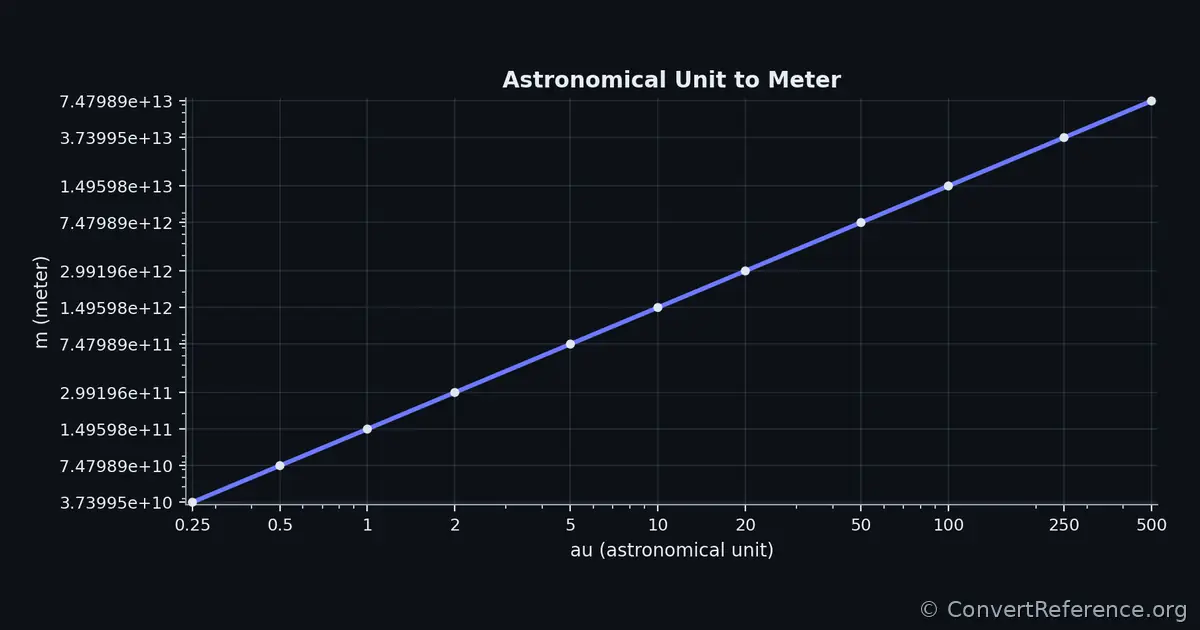
Astronomical units and Meters Conversion Graph
Conversion graph showing the relationship between astronomical units and meters.

Conversion Table For Astronomical Units And Meters

Common conversion values
Astronomical units Meters
0.253.73995e+10
0.57.47989e+10
11.49598e+11
22.99196e+11
57.47989e+11
101.49598e+12
202.99196e+12
507.47989e+12
1001.49598e+13
2503.73995e+13
5007.47989e+13

Values are rounded for display; internal calculations use the exact conversion factors between Astronomical Units and meters (149597870700 and 6.68458712226844e-12).

Dataset & API Access

Programmatic Access

Free JSON API with stable endpoints and predictable keys for automated bidirectional conversions.

Endpoint: https://convertreference.org/api/v1/convert/astronomical-unit-to-meter.json

Content Type: application/json

Documentation: View API docs

Licensing

License: CC0 1.0 Universal (Public Domain)

See all datasets

Data & Editorial Process

All numerical values and formulas are generated from the Pint scientific unit library (v0.25), using constants consistent with the BIPM SI Brochure (9th Edition) and NIST Special Publication 811. Explanatory text is drafted with AI assistance and reviewed by ConvertReference editors for clarity and accuracy. This converter is completely free to use, and all calculations are performed locally in your browser and never sent to a server.

  • 2025-12-01 – Generated: Page created using Pint v0.25 verified constants.
  • 2025-12-01 – Reviewed: Verified by ConvertReference editors; no numerical changes required.