ConvertReference.org

Parsec to Meter and Meter to Parsec Converter (pc to m, m to pc)

pc

Review And Reference Information

Verified by the ConvertReference Technical Standards Team

ConvertReference Technical Standards Team

All values and formulas are validated through our editorial review process and cross-checked against internationally recognized reference standards (NIST, BIPM, CODATA).

View Editorial Standards & Report Corrections

Last reviewed: December 01, 2025

Conversion Factors

1 parsec = 3.08567758146719e+16 meter
1 meter = 3.24077928946976e-17 parsec

(Exact factors: 3.08567758146719e+16 and 3.24077928946976e-17)

Sources: NIST · BIPM

About This Parsec And Meter Converter

Welcome to the Parsec and Meter converter, a quick and friendly tool for comparing these units. The input is in parsec and the output is in meter. You can swap the units with a button to switch between parsec and meter. Use it to explore space distances with clarity and ease.

What Are Parsecs And Meters?

What Is A Parsec?

Parsec (pc) is an astronomical unit of distance. It is the distance at which 1 AU subtends 1 arcsecond. Exact: 1 pc = 206,265 AU = 3.08567758e16 m (and 1 AU is defined as 149,597,870,700 m). Therefore 1 pc ≈ 3.086e16 m ≈ 3.26 light-years. System: astronomical distance unit, not an SI base unit; abbreviation pc. Example: Proxima Centauri is about 1.3 pc away (≈ 4.24 ly).

What Is A Meter?

Meter (m) is the SI base unit of length. It is defined as the distance light travels in vacuum in 1/299,792,458 of a second. This gives an exact, universal length. It belongs to the International System of Units (SI). Example: a standard doorway is about 2 meters tall.

When To Use Parsec Vs Meter

Parsec Usage

Parsec is used mainly in astronomy to express distances to stars and galaxies. It appears in scientific literature and education in several countries; primary examples include the United States, United Kingdom, Germany, and France.

Meter Usage

Meters are the standard unit of length in most countries and are used across science, education, manufacturing, construction, and consumer products. Examples of countries where meters are used include the United States, United Kingdom, Canada, and India.

How To Convert Between Parsecs And Meters

Conversion Formulas

Parsec to Meter:
parsec × 3.08567758146719e+16 = meter

Meter to Parsec:
meter × 3.24077928946976e-17 = parsec

Step-by-Step Guide

Parsec to Meter

  1. Take your value in parsecs.
  2. Multiply by 3.08567758146719e+16.
  3. The result is in meters.

Meter to Parsec

  1. Take your value in meters.
  2. Multiply by 3.24077928946976e-17.
  3. The result is in parsecs.

Example: Convert 2 parsecs to meters.

  • Exact: 2 × 3.08567758146719e+16 = 6.17135516293438e+16 meters.
  • Rounded: approximately 6.17136e+16 meters.

Example: Convert 5 meters to parsecs.

  • Exact: 5 × 3.24077928946976e-17 = 1.62038964473488e-16 parsecs.
  • Rounded: approximately 1.62039e-16 parsecs.

History & Context

Parsec is a unit used by astronomers to talk about very large distances. It was born from the idea of stellar parallax and a fixed angle defined in arcseconds, and a British astronomer coined the name by blending parallax and arcsecond. The term shows how tiny shifts in star positions helped map space. The meter began as a practical standard during the upheavals of the French Revolution, tied to a length based on the Earth’s shape and size. In the modern era, scientists redefine the meter by how far light travels in a vacuum during a defined moment, making it stable and universal.

Practical Use

Researchers planning a telescope survey convert a distance measured in parsecs into meters to align astronomical scales with lab-based calibration and detector measurements. In mission planning, engineers convert meters to parsecs to express a spacecraft's distance in astronomical terms for collaboration with scientists and to compare it with star catalogs. These conversions bridge local measurements and cosmological context, enabling accurate planning and communication across disciplines.

Common Mistakes When Converting Between Parsecs And Meters

  • Confusing parsec with a light-year.
  • Treating parsec as a unit of time rather than a distance.
  • Assuming a single fixed conversion factor applies to every distance.
  • Forgetting that a parsec is defined from parallax and angular measurements.

Mental Shortcuts For Quick Conversions

Memorization method: 1 parsec ≈ 3.1e16 meters (3.1 with 16 zeros) for quick estimates. For meters to parsecs: 1 meter ≈ 3.2e-17 parsecs (the reciprocal). Note: these are rough estimates; use a precise converter when accuracy matters.

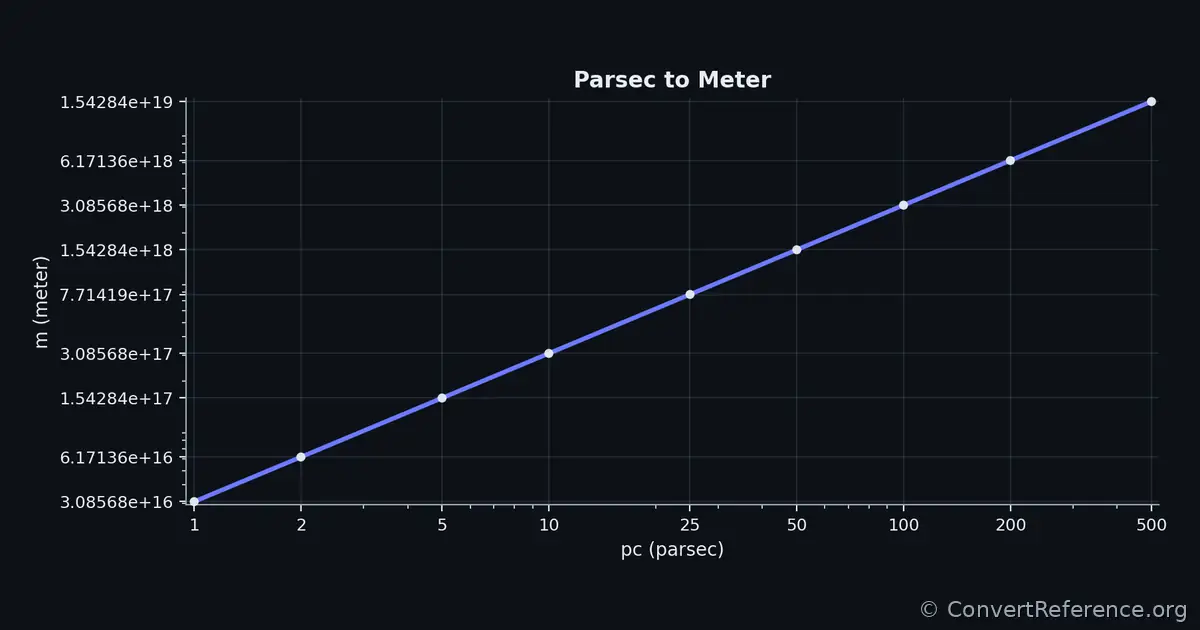
Parsecs And Meters Conversion Graph

Parsecs and Meters Conversion Graph
Conversion graph showing the relationship between parsecs and meters.

Conversion Table For Parsecs And Meters

Common conversion values
Parsecs Meters
13.08568e+16
26.17136e+16
51.54284e+17
103.08568e+17
257.71419e+17
501.54284e+18
1003.08568e+18
2006.17136e+18
5001.54284e+19

Values are rounded for display; internal calculations use the exact conversion factors between parsecs and meters (3.08567758146719e+16 and 3.24077928946976e-17).

Dataset & API Access

Programmatic Access

Free JSON API with stable endpoints and predictable keys for automated bidirectional conversions.

Endpoint: https://convertreference.org/api/v1/convert/parsec-to-meter.json

Content Type: application/json

Documentation: View API docs

Licensing

License: CC0 1.0 Universal (Public Domain)

See all datasets

Data & Editorial Process

All numerical values and formulas are generated from the Pint scientific unit library (v0.25), using constants consistent with the BIPM SI Brochure (9th Edition) and NIST Special Publication 811. Explanatory text is drafted with AI assistance and reviewed by ConvertReference editors for clarity and accuracy. This converter is completely free to use, and all calculations are performed locally in your browser and never sent to a server.

  • 2025-12-01 – Generated: Page created using Pint v0.25 verified constants.
  • 2025-12-01 – Reviewed: Verified by ConvertReference editors; no numerical changes required.